Negotiation and trading games, explained: what can be traded, who can trade, and when a promise binds
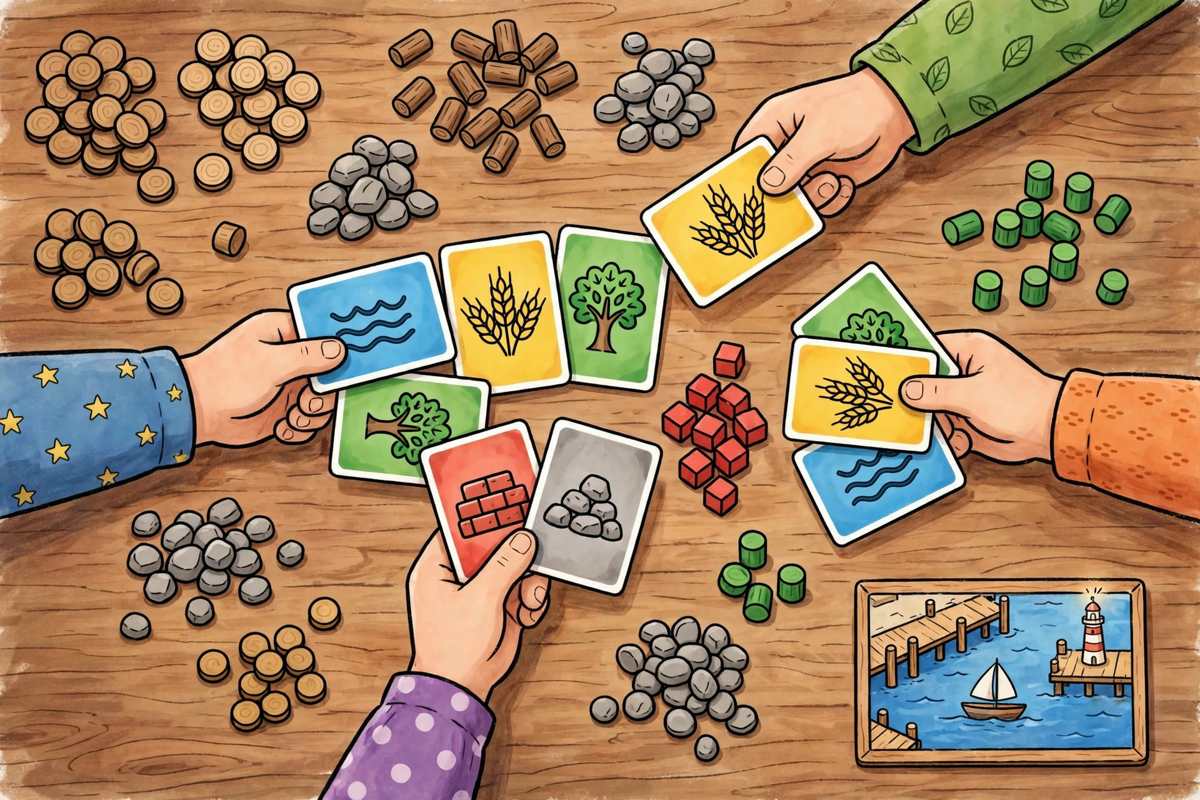
The common picture of a negotiation game is a free for all, everyone shouting offers at once, anything tradable, promises worth exactly as much as the person making them. One of the three games below actually works that way. The other two are far stricter, and the strictness is the point. Catan only lets you trade with the player whose turn it is. Bohnanza only lets the active player trade at all. Chinatown, by contrast, opens the floor to everyone and calls its trade phase, in the words its reviewers keep quoting, anything goes. Same shelf label, three different contracts.
That distinction matters more than any ranking of titles. A group that loves open haggling can bounce hard off a game where trading is a short, turn bound exchange. A group that wants deals contained can find an open floor exhausting. So read a negotiation game the way you would read a contract: what may change hands, who is allowed at the table, and what, if anything, forces a promise to be kept.
The facts box: three trading contracts, spec checked
Catan splits trading in two. Domestic trade is player to player, and maritime trade is with the supply at fixed rates. Bohnanza, designed by Uwe Rosenberg and published by AMIGO, is a card game about planting, trading, and harvesting beans, for 2 to 7 players in current editions, ages 10 and up, at about 45 minutes. Its base game for 3 to 5 players holds 104 bean cards across 8 types. Chinatown, designed by Karsten Hartwig, was originally released in 1999 by Alea and later reprinted by Z-Man Games. It runs 3 to 5 players over 6 rounds representing the years 1965 to 1970, on a board of 85 business plots, with each player starting on 50,000 dollars.
| Contract term (verified Nov 16, 2026) | Catan | Bohnanza | Chinatown |
|---|---|---|---|
| Who may trade | Only with the player whose turn it is; other players may not trade among themselves | Only the active player may trade; non active players cannot trade with each other | Everyone, in an open trade phase |
| What may be traded | Resource cards, at any rate both sides accept; like resources may not be traded for like | Bean cards from hand and the two turned over cards; a card received in a trade cannot be traded again | Shop tiles, building lots, lots with placed businesses, and money, in any combination |
| Fixed price fallback | Maritime trade at 4 to 1, improving to 3 to 1 at a generic harbour and 2 to 1 at a special harbour | None; an unwanted bean must be planted, traded, or given away in the trade step | None; income comes from completed businesses, and money itself is the score |
| Future promises | Trading happens on the active turn, so deals are settled in the moment | Deals settle in the turn, and traded beans are planted in the same turn | Not enforceable; immediate agreements must be honoured, future promises do not have to be kept |
| Players and time | Trading is one phase of a turn, not a timed round | 2 to 7 players, about 45 minutes | 3 to 5 players, 6 rounds, trade phase suggested at 5 to 10 minutes a round |
Bohnanza earns its trading pressure from a rule that has nothing to do with talking. Cards stay exactly in the order they were received, and the hand may never be reordered. A turn runs in four phases: plant, turn over two cards and trade, plant the beans gained in trades, then draw three cards to the back of the hand. Because the front card must be planted, an unwanted bean is a deadline, not an inconvenience. Trading is how a player disposes of a problem before it takes over one of their few fields.
The bank rate is the anchor nobody names
Catan quietly publishes the price ceiling for every negotiation at the table. Maritime trade is always available at 4 to 1, four identical resource cards for any one card, no harbour needed. A settlement or city on a generic harbour improves that to 3 to 1, and a special harbour gives 2 to 1 for the resource shown. Those numbers turn haggling from theatre into arithmetic.
Use them as a refusal rule. If a player asks for more than the bank would charge you, the correct answer is usually no, however friendly the pitch. If a player offers a trade that beats your bank rate, it deserves a fast yes before the offer moves on. The one exception is information: a deal at exactly the bank rate can still be worth taking when it denies the resource to the player who is about to win, or when the timing, this turn rather than after another roll, is the real value. What the anchor removes is the vague middle, the deals accepted because refusing felt rude.
Neither Bohnanza nor Chinatown gives you that safety net, which is exactly why their trading feels louder. With no fixed price to point at, every value is argued from the board: how close a field or a business is to completion, and how many rounds remain for it to pay out. In Chinatown that argument has a hard edge, because money is the only thing that counts at the end. Paying cash for a tile is trading points for the prospect of future points, and late in the six rounds that prospect shrinks fast.
When a promise binds, and when it does not
Chinatown draws the line clearly, and every negotiation group should steal the distinction even if they never play the game. An agreement that completes immediately must be honoured, cash payments included. A promise about the future does not have to be kept, and the rules translation states that in plain terms, with an example trade of a plot now against a restaurant tile that might turn up later. Nothing in the game enforces a future promise, and there is no rule stopping players from trying to enforce one socially either.
The other two games mostly dodge the problem by design. Catan trades settle inside the active turn, with both sides handing over cards at once. Bohnanza goes further: beans gained in a trade are planted in that same turn, and a card received in a trade cannot be passed on again. When settlement is instant, trust stops being a mechanic. The lesson travels well. The longer a game lets a deal stay open, the more of the evening will be spent arguing about the deal instead of playing the game.
The two minute agreement to settle before round one
This topic suits a short procedure, because the failure mode is social, not rules based. Settle these points before the first trade, while nobody is winning yet:
- Timebox the floor. Chinatown suggests 5 to 10 minutes for its trade phase each round. Adopt a number, name who calls time, and let unfinished deals die when it expires.
- Declare the promise rule. State out loud whether future promises bind at your table. The published Chinatown position is that they do not. If your group wants them binding, say so before anyone relies on one.
- Agree the leader rule. Decide whether trading with the player in front is simply allowed, or whether the table will refuse deals that hand that player the win. Either position works. Discovering the disagreement in round five does not.
- Name the take back line. Once cards, tiles, or money have changed hands and the next phase has started, the deal is closed. In Chinatown a placed shop tile may never be removed, which makes the placement step a natural point of no return.
Success looks like this: the first broken expectation, a refused trade, a promise tested, a deal with the leader, gets handled by pointing at the agreement rather than by relitigating it. If the table spends longer arguing the agreement than a trade phase lasts, the agreement was too vague. Shorten it and restart the clock.
Who will love it, who should skip it
Pick Chinatown for a group that wants the deal itself to be the game, open floor, almost anything tradable, and a score kept in the same money being haggled over. Pick Bohnanza for a louder, shorter evening where the pressure comes from a hand that cannot be reordered and fields that cannot wait, in about 45 minutes. Pick Catan when the group wants negotiation as one lever among several, bounded by the active turn and backstopped by the bank rate.
Skip the whole shelf where the group dislikes direct conflict over value, where one player will dominate every conversation, or where a broken future promise would follow people home. Those are not flaws the next title fixes. They are the product, priced into all three contracts, and the honest move is to choose a game where nobody has to sell anything to anybody.
— Rex Bennett, Entertainment Writer